Letting go: the piece in my hands vs. the piece in my head
People often assume the best moment is when a piece is finished, but for me it’s more complicated than that.

The Impossible Comparison
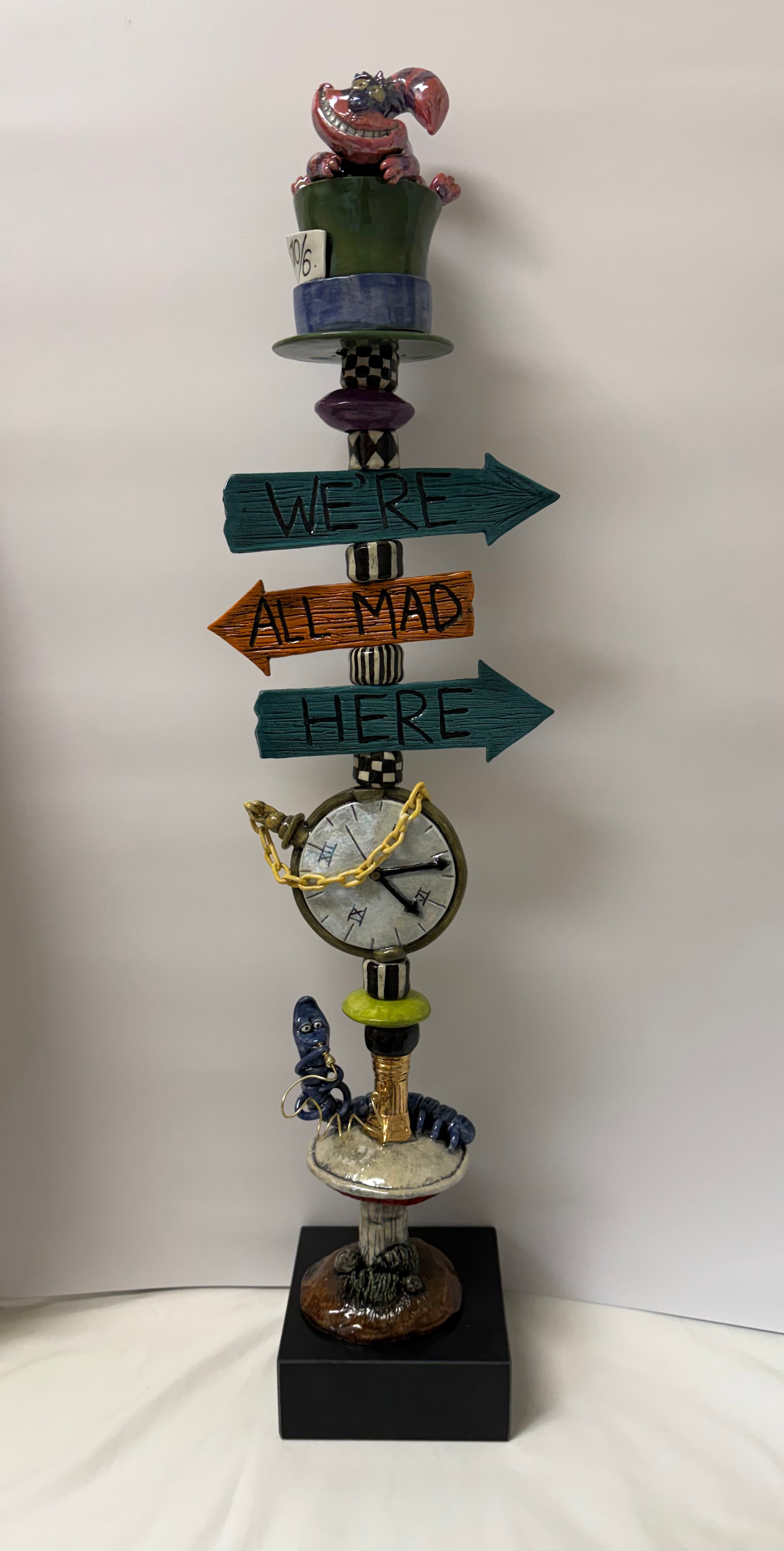
I just recently “finished” my Wonderland stack. After hours of brainstorming, engineering, sculpting, firing, glazing and finally assembling, I stepped back to look at it and was struck with the familiar feeling I’ve come to accept.
“Meh.”
Not terrible. Not amazing. Just… not the perfect thing that had been living in my imagination. I am my own worst critic.
I almost never love a piece the moment it’s finished. The process doesn’t stop there. A mental shift has to happen for me. I start with an idea in my head and when the piece is finished I am comparing it to that vision. The imagined reality.
I’m comparing it to something impossible and intangible.
When the Idea Meets Physics
My imagination doesn’t take into account all the artistic decisions that have to be made. Consideration of rod placement, actual glaze colors, firing variations, stacking order and balance. In my head everything works perfectly. The proportions are right, the glazes behave exactly how I imagine them, and gravity happily cooperates.
I hope over time these things will become easier to predict and plan for. I guess that’s all part of the learning process and the reason I love working with clay and creating. I love learning new things more than anything. It’s almost a hobby in itself for me and clay allows me endless opportunities to learn.
Originally the base for the Wonderland stack was going to be the bottom half of Alice with her feet in the air like she was falling into the rabbit hole. I loved this idea and thought it would ground the whole piece. However, the only place I could place the rod and not make it obvious, which is always my goal, was to run it through one of her legs.

The rod that runs through the stack is structurally necessary, but visually I want it to disappear. If someone notices it first, the illusion is broken.
Well… it looked like Alice had a case of gout. Her leg had to be too thick, and in an unnatural position to make it work in my opinion. So I moved on to other ideas and decided on the caterpillar.
The pieces were fired multiple times. That’s one of the hidden parts of ceramic work—pieces rarely go into the kiln just once. Especially if they had gold or Mother of Pearl luster on them, which most did. They first went through a cone 04 bisque firing, were glazed, fired to cone 5, and then 019 for the lusters.
A happy side note: I treated myself to a little baby Skutt kiln for my birthday so that I could do smaller loads and not feel so guilty firing my big kiln barely loaded.

Finding the Balance
Once complete though, the stacking process begins. Everything is threaded onto the rod and I step back to look at the overall balance. It just didn’t sit well with me. It seemed too tall and had a “Drink Me” bottle that felt out of place. It had been created when Alice’s feet were still the base.
So I removed it and played with the pieces I had left. Trying many combinations, trying to get a balanced feeling, I finally settled on the order.
Learning to Walk Away
Now the process of stepping back and critiquing it begins. This one was a tough one. After making so many decisions and moving away from my original vision, trying to see the finished piece with an open mind is hard.
I find that I have to walk away and give it at least a day. I find myself peeking at it every so often to see how I feel about it. Inevitably over time my original vision fades and the concrete version takes over and I can see it for what it is.
Letting the Real Piece Speak
There’s almost a sigh of relief once this happens and I can accept what is in front of me.
Each stack teaches me new lessons and I feel myself growing as an artist. I love brainstorming for the next idea. Once something takes hold I can’t help but grab its hand and run with it.
My next stack is going to be dessert themed. I LOVE a good dessert and am looking forward to seeing personalities emerge.
I’m slowly learning that the piece in my head isn’t the goal. It can’t be. The real piece has its own story and voice and I need to honor and accept that.
They’re both “me.” One is the catalyst for the other. They can work together, not against each other.





Leave a Reply